MCAT Science Topics & Subject Master Syllabus
Comprehensive guide to all Physics, General Chemistry, Organic Chemistry, Biochemistry, and Biology subjects tested on the MCAT.
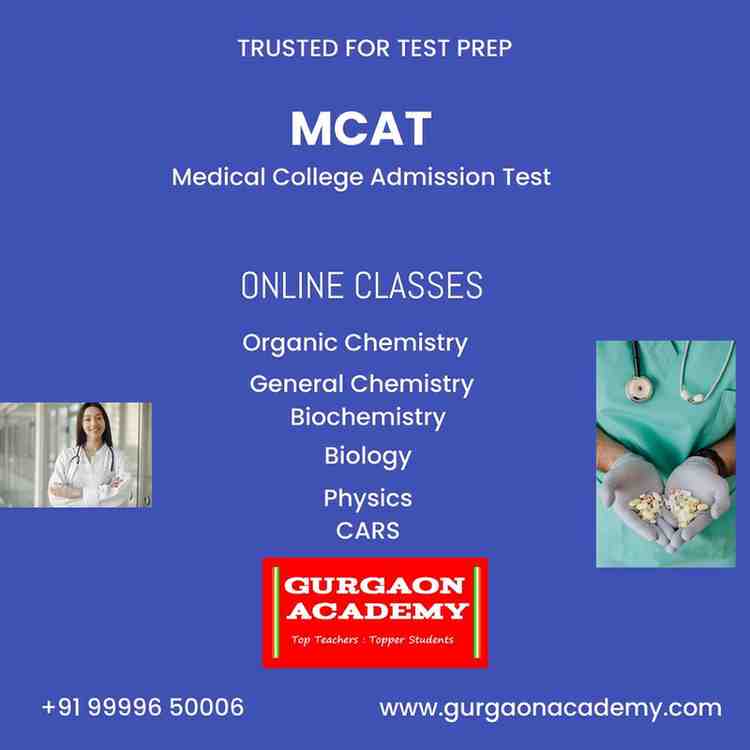
Expertly structured coaching at Gurgaon Academy to build conceptual mastery, shortcut solving speed, and high-percentile test confidence.

1. Chemical & Physical Foundations Topics
Core physical science topics required for high scores on the MCAT.
Physics Subjects to Study
- Units & Dimensional Analysis
- Kinematics (1D & 2D Motion)
- Work, Energy & Conservation Laws
- Fluids, Pressure & Hydrostatics
- Waves, Harmonic Motion & Sound
- Light & Geometrical Optics
- Thermodynamics & Heat Transfer
- Electrostatics & Electric Fields
- DC Circuits & Kirchhoff’s Laws
- Magnetism & Electromagnetic Induction
- Atomic & Nuclear Phenomena
General Chemistry Subjects to Study
- Atomic Structure & Quantum Numbers
- The Periodic Table & Periodic Trends
- Bonding & Chemical Interactions
- Stoichiometry & Mole Concept
- Chemical Kinetics & Reaction Rates
- Equilibrium & Le Chatelier’s Principle
- Thermochemistry & Energetics
- Gas Phase Laws & Solutions
- Acids, Bases, Buffers & Titrations
- Redox Reactions & Electrochemistry
2. Biological & Biochemical Foundations Topics
High-yield organic, biochemical, biological, and physiological topics.
Organic Chemistry
- IUPAC Nomenclature & Isomers
- Bonding & Molecular Structure
- Alcohols, Ethers & Epoxides
- Aldehydes & Ketones
- Carboxylic Acids & Derivatives
- Nucleophiles & Electrophiles
- Organic Redox Reactions
- Nitrogen & Phosphorus Compounds
- IR, NMR & UV Spectroscopy
- Lab Techniques & Separations
Biochemistry & Macromolecules
- Amino Acids, Peptides & Protein Structure
- Oxygen Transporters (Hemoglobin/Myoglobin)
- Enzymes, Zymogens & Kinetics
- Connective Tissue & Nonenzymatic Proteins
- Carbohydrate Structure & Metabolism
- Lipids & Lipid Metabolism
- DNA, RNA & Biological Membranes
- Metabolic Integration & Regulation
- Glycolysis, Krebs Cycle & Oxidative Phosphorylation
- Gluconeogenesis, Glycogen & Urea Cycle
Cell Biology & Genetics
- Biological Membranes & Transport
- Prokaryotes vs Eukaryotic Cells
- Signal Transduction Pathways
- Gene Expression & Transcription
- Cellular Reproduction & Meiosis
- Transmission & Human Genetics
- Recombination, Mutation & Evolution
- Viruses, Prions & Molecular Lab Tech
- Tissues, Histology & Embryology
Human Physiology Topics (Organ Systems)
Comprehensive breakdown of human body systems tested on the MCAT:
- Nervous System: Central, peripheral, autonomic, and action potentials
- Sensory Systems: Vision, hearing, taste, smell, and somatosensation
- Endocrine System: Peptide/steroid hormones and feedback loops
- Musculoskeletal System: Skeletal, smooth, cardiac muscle, and bone remodeling
- Cardiovascular System: Cardiac cycle, blood pressure regulation, and hemodynamics
- Blood: Components, gas transport, and clotting cascades
- Respiratory System: Gas exchange, lung volumes, and pH regulation
- Lymphatic & Immunity: Innate vs adaptive immunity and lymph flow
- Urinary System: Nephron function, osmoregulation, and GFR
- Digestive & Nutrition: Enzyme secretions, absorption, and liver function
- Reproductive System: Male/female anatomy, gametogenesis, and cycles
Flexible Modes of Study
Available worldwide via live interactive digital whiteboards or in-person private home tutoring across Gurgaon NCR:
4 Simple Steps to Begin MCAT Coaching
Get in Touch
Submit an enquiry online or reach out via phone/WhatsApp (+91 99996 50006).
Diagnostic Review
Evaluate your target exam date, target score, and subject proficiency.
Module Selection
Choose full course coaching or targeted subject modules (e.g., Physics, Bio/Chem).
Start Prep
Begin live classes, formula drills, practice worksheets, and mock tests.
Frequently Asked Questions – MCAT Science Topics
1. Are calculators permitted on the MCAT Physical Sciences section?
No, calculators are not allowed on the MCAT. At Gurgaon Academy, we teach dimensional analysis, scientific notation shortcuts, and mental estimation techniques so you can solve physics and chemistry numericals quickly.
View Course Fees →2. Can I study specific subject modules instead of the full course?
Yes! Students can enroll in specific subject modules (e.g., Physics only, Organic Chemistry only, or Biochemistry/Biology) based on their diagnostic needs.
Enquire Course Modules →3. How are remote online sessions conducted for international students?
We conduct live 1-on-1 and small group sessions via Zoom, Google Meet, and MS Teams equipped with interactive digital whiteboards and instant class notes.
Book a FREE Demo Class →Ready to Master the MCAT Syllabus?
Join Gurgaon Academy today and receive comprehensive, exam-targeted preparation from expert pre-med faculty.
Call / WhatsApp Us: +91 99996 50006
Email: Gurgaon.Tutor@gmail.com | Web: www.gurgaonacademy.com